
How to Shift From Passive Reading to Deep, Personal Connection in Your Daily Quiet Time
Picture your typical morning routine:
You carve out a few peaceful minutes before the day gets busy, open a daily devotional book or a quick morning reading, skim the one-page entry, read the single verse at the bottom, and close the book. You feel good knowing you made space for God before starting your day.
But by lunch, if someone asked you what the devotional was about, could you summarize the main truth or recall how it applied to your life?
If the answer is no, you are far from alone.
Millions of intentional believers fall into the exact same cycle every day. We assume that reading about God is the same thing as connecting with Him. But in reality, relying solely on pre-written readings is one of the most common anti-patterns in daily quiet times: The "Borrowed Faith" Trap.
When devotions become something you passively consume rather than actively process, your faith walk stays on the surface. Here is why passive reading leaves you feeling unfulfilled, and how shifting to active guided reflection transforms your mornings.
3 Signs You’re Caught in the "Borrowed Faith" Cycle
How do you know if your daily quiet time routine has shifted from true connection into passive reading? Look for these three subtle signs:
- The Mid-Morning Blank: You spent time reading a entry this morning, but by lunch you can't recall the core message or key scripture without opening the book again.
- Devotional Hopping: You finish one 30-day or 90-day book and immediately jump into another, hoping the next author's style will finally unlock the breakthrough you're looking for.
- Praying in Generalities: Because you aren't writing down specific petitions, your prayers tend to repeat the exact same broad phrases day after day.
If you recognize these patterns don't feel guilt. It's simply a sign that your mind is ready for a more interactive daily quiet time routine.
The Difference Between Consumption and Connection
Reading a daily devotional is not inherently bad—it can be a wonderful spark of inspiration. However, when passive reading becomes your entire quiet time, subtle spiritual hurdles occur:
1. High Consumption, Zero Retention
When you passively read someone else's thoughts, your brain operates in a low-engagement state. Without actively processing the words, putting pen to paper, or asking how the truth applies to your current season, the message slips through your mind like water through a sieve.
Scripture gives us a vivid picture of this exact experience in James 1:23–24:
"Anyone who listens to the word but does not do what it says is like someone who looks at his face in a mirror and, after looking at himself, goes away and immediately forgets what he looks like."
When we passively skim a devotional entry without meditating on it, we look in the mirror of truth for thirty seconds, and then immediately walk away and forget it.
2. Living on "Borrowed Faith"
A devotional book gives you someone else’s revelations, someone else’s prayers, and someone else’s takeaways. While their insights may be beautiful, they are still second-hand. True spiritual growth happens when you move past what an author learned and begin discovering what God is saying directly to you.
3. The "Check-the-Box" Illusion
Because reading takes very little mental effort, it is easy to use it as a spiritual checklist. You read the page, tick the mental box, and move on with your day—without ever sitting in quiet reflection, bringing your personal worries to God, or writing out your genuine prayers.
Passive Consumption vs. Active Processing
Here is how your morning quiet time shifts when you move from simply reading to actively processing God's Word:
| PASSIVE CONSUMPTION (Reading Only) | ACTIVE PROCESSING (Guided Writing) |
|---|---|
| • Skimming an author's thoughts | • Writing your own personal takeaways |
| • Forgetting the main point by noon | • Anchoring truth through active engagement |
| • Relying on second-hand faith | • Hearing God's voice for your own season |
| • Treating quiet time as a task | • Experiencing genuine heart connection |
3 Ways to Move From Passive Reader to Active Participant
If you want your daily quiet time to produce real peace, clarity, and spiritual depth, shift your approach with three simple steps:
Step 1: Engage Your Pen
Educational psychology proves that the physical act of writing engages the brain in deep cognitive processing. When you write down a scripture verse, a prayer, or a personal thought, you transfer that truth from short-term memory into lasting heart conviction.
In Psalm 119:15, the Psalmist shares the key to lasting retention:
"I meditate on your precepts and consider your ways."
Meditation isn't rushing through five pages of text, but it's slowing down with one truth and considering how it shapes your heart.
Step 2: Ask Personal Application Questions
Instead of closing your book as soon as you finish reading, pause and ask yourself two simple questions:
- What does this reveal about God's character today?
- How is He inviting me to trust Him in my current circumstances?
Step 3: Write Out Your Own Prayers
Stop relying solely on pre-written prayers. Putting your own specific needs, family worries, and gratitude into written words keeps your mind anchored during prayer and creates an ongoing record of God's faithfulness over time.
From Passive Skimming to Personal Connection
A good devotional can spark inspiration, but reading alone is only half the journey. Pair your daily reading with a peaceful, structured space that invites you to respond, reflect, and connect.
That is why Sunday Soul Notes® was created as an interactive guided framework rather than a book of pre-written essays.
Instead of keeping you in a passive reading mode, Sunday Soul Notes® gives you the exact tools needed to become an active participant in your faith walk:
- 26 Weekly Meditations & Prompts: Thoughtful, open-ended questions designed to draw out your thoughts and help you apply God's Word to your daily life.
- 12 Weeks of Structured Prayer Spaces: Dedicated sections to write out your personal petitions, family needs, and ongoing praise reports.
- Everyday Gratitude Sections: Pre-formatted pages that prompt you to actively identify God's goodness in your day-to-day routine.
- 126 Curated Seasonal Scriptures: Clear scripture focus points that give your mind an anchor to meditate on and write about.

Ready to Experience Deeper, More Personal Quiet Times?
Step into a guided practice where your voice, your prayers, and your personal faith walk take center stage.
Shop the Journal →
Want to test out a guided layout first?
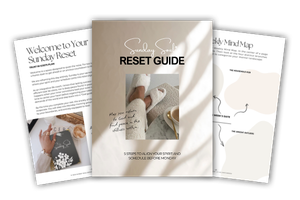
Click here to download our free Sunday Soul Reset Guide: 5 Steps to Align Your Spirit and Schedule Before Monday
to bring active depth back to your morning devotions.

0 Comments