
Overcoming Decision Fatigue, Perfectionism, and Blank-Page Paralysis in Your Faith Walk
Whenever we set up shop at events or connect with women in person, we love asking about their quiet time routines. As women pick up Sunday Soul Notes, flip through the heavy gold coil, and feel the linen cover, we hear the exact same confession over and over again:
"I love this so much, but if I'm being honest... I already have like four journals sitting at home that I haven't even used."
If you have a collection of beautiful notebooks gathering dust, you are in good company.
Most assume an abandoned journal is a personal flaw. We tell ourselves we lack discipline, or journaling isn't for us.
That narrative is false. Unfinished prayer journals rarely happen because of a lack of faith or effort. They happen because blank journals ask your brain to do a heavy lift without giving you any structural support.
Here is the science of why journal abandonment happens—and how a guided structure changes everything.
The Psychology Behind the "Journal Graveyard"
Understanding why your brain resists blank pages helps remove the shame and allows you to build a system that works with your mind instead of against it.
THE 3 PSYCHOLOGICAL BARRIERS
- DECISION FATIGUE — Blank pages drain brain power before you even begin writing.
- ALL-OR-NOTHING THINKING — Missed days trigger perfectionism & shame, causing total avoidance.
- RUMINATION — Dumping thoughts without prompts loops anxiety instead of resolving it.
1. Decision Fatigue & Choice Overload
In psychology, decision fatigue occurs when your prefrontal cortex is forced to make endless choices in a short period.
When you open a blank, unformatted notebook, your brain has to make several micro-decisions before you write a single word: Where do I start? How should I format this page? What scripture should I pick? Should I write my prayers or my goals first?
When you sit down early in the morning, or at the end of a long day, your executive function is already running low. Faced with the choice overload of a blank white sheet, your brain chooses the path of least resistance: closing the notebook.
2. The "All-or-Nothing" Cognitive Bias
Perfectionism is a cognitive distortion where we view situations in black-and-white terms. You start a journal with momentum, writing five days in a row. Then life happens—a sick child, a busy work week, or an exhausting morning—and you miss three days.
Instead of simply picking up where you left off on day nine, your brain interprets the blank gap as a broken streak. Looking at those empty pages activates mild guilt and shame. To protect yourself from feeling like you failed, your brain avoids opening the journal altogether.
3. Rumination vs. Cognitive Reappraisal
There is a massive difference between venting on paper and processing on paper.
Psychological research shows that writing down unstructured, stream-of-consciousness thoughts without a reframing tool often leads to rumination—spinning the same worries over and over without reaching resolution.
Without targeted prompts to guide your mind toward gratitude, truth, or structured prayer, journaling turns into a written list of anxieties. When an activity leaves you feeling more scattered than when you started, your mind naturally stops prioritizing it.
The Shift: Targeted Prompts Beat Unstructured Hours
This is why sitting down for 30 minutes with a blank notebook often feels frustrating. You spend most of that time trying to summon inspiration or organizing your thoughts in real-time.
Targeted reflection is different.
When you use a guided framework, five focused minutes accomplishes far more than 30 unguided minutes.
Instead of staring into space waiting for a thought to arrive, a prompt gives your mind a clear destination. You aren't inventing the road; you are simply walking on it. This eliminates decision fatigue, grounds your focus, and brings immediate mental and spiritual relief.
How Sunday Soul Notes Eliminates the Friction
When we created Sunday Soul Notes®, we didn't want to design another notebook that ends up forgotten in a drawer. We built a home for your faith walk engineered to dismantle those three psychological barriers:
- Eliminates Decision Fatigue: You never have to ask "What should I write?" Pre-formatted sections for Sunday service notes, seasonal scriptures, and guided prayer prompts walk you through every step.
- Removes "Date Guilt": Pages are structured by weeks, routines, and seasons rather than strict calendar dates. If you miss a week during a crazy season, there are no dated blank gaps shaming you. You turn the page and keep going.
- Guides You From Anxiety to Resolution: With 19 dedicated pages for everyday gratitude, 26 weekly meditations, and structured prayer categories, the prompts gently pull your mind out of rumination and anchor it back in peace.
Stop Collecting Blank Pages
You do not need more willpower to stay consistent in your devotions. You simply need a tool that supports your mind instead of demanding extra energy from it.
Give yourself permission to put down the intimidating blank notebooks. Step into a structured, peaceful rhythm where your thoughts have a home, your prayers have direction, and your journal gets finished.

READY FOR A JOURNAL YOU’LL FINISH?
Experience a guided, structured layout designed to eliminate blank-page burnout and keep your faith walk grounded all year long.
Shop the Journal →
Want to test out a guided layout first?
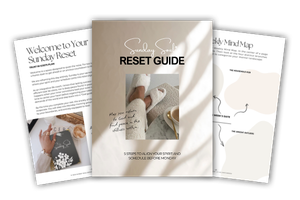
Click here to download our free Sunday Soul Rest Guide: 5 Steps to Align Your Spirit and Schedule Before Monday
to experience how simple guided prayer life feels before ordering your journal.

0 Comments